
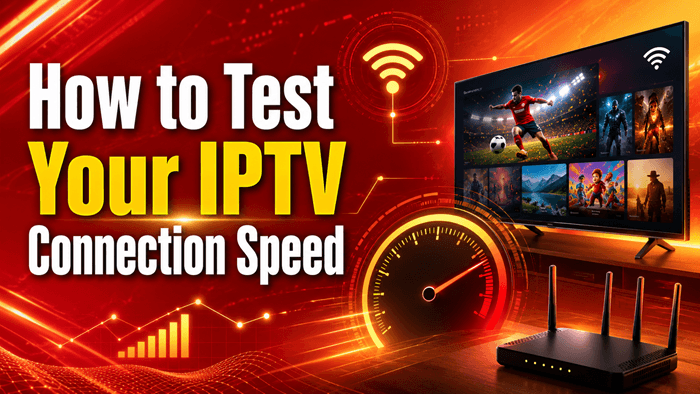
How to Test Your IPTV Connection Speed (Step-by-Step Guide)
If your IPTV keeps buffering and you want to know whether your internet is the problem, test your connection speed on the same device you stream with, check your download speed against the resolution you watch, then verify stability by measuring ping, jitter, and packet loss during peak hours. IPTV streams video over your internet connection in real time, so a steady, low-latency link matters far more than a high headline number. This guide walks you through how to test your speed correctly, which metrics actually affect streaming, how to test the IPTV stream itself, and what to do when the numbers come back too low.
How Much Internet Speed Does IPTV Need?
How much speed you actually need depends on the resolution you watch and how many people are streaming at home at the same time. Standard definition uses very little bandwidth, while 4K demands a serious connection. The figures below reflect per-stream recommendations, not just bare minimums.
| Resolution | Minimum Speed | Recommended (with headroom) |
| SD (480p) | 3–5 Mbps | 5 Mbps |
| HD (720p/1080p) | 5–10 Mbps | 10–25 Mbps |
| Full HD (1080p) | 8–12 Mbps | 15–25 Mbps |
| 4K / Ultra HD | 25 Mbps | 35–50 Mbps |
A single 4K stream needs at least 25 Mbps, but most experts suggest 35 to 50 Mbps for a truly seamless experience because of the large data volume involved. 4K HDR is even more demanding, since the wider color range pushes peak bitrates higher, so plan for 45 to 60 Mbps per stream if you watch HDR movies or sports. If several people stream at once, add the per-stream numbers together and pad the total to cover overhead.
Top IPTV Picks
Verified this month






How Much Speed Do I Need for 2, 3, or 4 Devices at Once?
When more than one device streams at the same time, your bandwidth needs add up fast, and a connection that handles a single stream easily can choke under a full household. The simple method is to multiply the per-stream requirement by the number of simultaneous streams, then add a buffer of 15 to 30 percent for overhead and background activity.
- 2 devices (HD): roughly 20 to 50 Mbps total. Two HD streams plus everyday browsing sit comfortably on a 50 Mbps plan.
- 3 devices (mixed HD/Full HD): roughly 45 to 70 Mbps. Three HD streams alone use 15 to 24 Mbps, but adding gaming or video calls pushes the total much higher.
- 4 devices (including 4K): 100 Mbps or more. Two 4K streams plus a couple of HD streams quickly approach the limit of a 100 Mbps line, and a busy family is better served by 150 to 200 Mbps fiber.
Remember that your connection is shared across everything in the house. Smart TVs, phones, security cameras, and consoles all draw bandwidth even when no one is actively streaming, so plan for your busiest evening, not a quiet afternoon.
How to Test Your Internet Speed for IPTV
A speed test takes under a minute, but doing it correctly is what makes the result meaningful. Follow these three steps in order.
Run a Standard Speed Test (Download, Upload, Ping)
Open a trusted tool like Speedtest.net or Cloudflare’s speed test at speed.cloudflare.com in your browser or app. Click start and let it finish all measurements: download, upload, and ping, plus jitter and packet loss if the tool reports them. Write down each number rather than just glancing at the download figure, since the others reveal whether your connection is stable enough for live TV.
Test on the Device You Stream On
If you watch IPTV on a Fire TV Stick in the bedroom but run the speed test on your laptop in another room, the result won’t tell you what your stream is really getting. Run the test on the actual streaming device, whether that is an Android box, a smart TV, or a Firestick, using a speed test app from its store. The result reflects the Wi-Fi signal and hardware your stream actually relies on.
Test During Peak Viewing Hours
Internet speeds drop during evenings when your whole neighborhood is online. Test once in the afternoon and again between 7 PM and 11 PM. If your IPTV only buffers at night but works fine during the day, a connection that reads 60 Mbps at noon and collapses to 15 Mbps at 9 PM is usually the reason.
Which Speed Test Numbers Actually Matter for IPTV
Download speed gets all the attention, but three quieter numbers decide whether your stream stays smooth.
- Download speed: how fast data arrives. This must clear your resolution’s requirement with room to spare.
- Upload speed: often ignored, but it carries the requests your player sends back to the server. A weak upload can cause stalls even with strong download.
- Ping (latency): the delay between your device and the server, measured in milliseconds. Under 40 ms is excellent, 40 to 80 ms is acceptable, and anything above 150 ms tends to cause buffering on live channels.
- Jitter: the variation in ping over time. Steady ping is good; ping that swings wildly causes stutter and even robotic audio, because packets arrive out of order.
- Packet loss: data that never arrives. Even 0.5 to 1 percent loss produces freezing and pixelation, so your target is zero.
Why Good Speed Still Buffers: Bitrate, Codecs, and Real Speed Explained
IPTV channels stream at a fixed bitrate, and your connection has to comfortably exceed that bitrate every second, not just on average. A 1080p stream might run at 8 to 12 Mbps of actual video data. If your real-world speed dips below that for even a few seconds, the player runs out of buffer and freezes.
Your real streaming speed is usually lower than what your provider advertises. Wi-Fi loss, background app updates, and other devices all eat into the total, so a 20 Mbps plan might deliver only 8 to 10 Mbps to your stream in practice. ISP speeds are “up to” figures, and during peak hours you often get only 70 to 80 percent of the advertised number. That gap is why a connection that passes the minimum test still buffers.
Codecs change the equation, too. Modern streams using HEVC (H.265) compress video roughly 30 to 50 percent more efficiently than older H.264, and AV1 is more efficient still. If your IPTV provider and your device both support HEVC or AV1, the same picture quality needs noticeably less bandwidth. Older devices stuck on H.264 will demand more speed for identical visuals.
How to Check If the Problem Is the IPTV Server, Not Your Wi-Fi
A general speed test measures your link to the wider internet. It does not measure the path to your IPTV provider’s server, which is where many problems actually live.
Built-in Player and App Indicators
Most IPTV players show a live bitrate or buffer indicator during playback, often accessible through the info button or a settings overlay. Watch this number while a channel plays. If the bitrate constantly drops or the buffer keeps emptying while your speed test looks healthy, the bottleneck is the stream or the server, not your home internet.
Testing Server Routing With Ping and Traceroute
You can test the route to your provider directly. On a computer, open the command prompt or terminal and run a ping to the server address, then a traceroute, to see where delays appear along the path. High ping or timeouts at a particular hop point to a routing or provider-side issue rather than your own connection. If your general internet is fast but the route to the IPTV server is slow, no amount of upgrading your home plan will help.
How to Tell If It’s Your Internet or Your IPTV Provider
When buffering persists, the most useful thing you can do is isolate the cause before spending money on a plan upgrade or a new subscription. A few quick checks usually point to the culprit.
- Test other streaming apps. If Netflix or YouTube play in 4K without trouble but only IPTV buffers, your internet is fine and the issue is the provider or its servers.
- Switch channels or servers. If one channel freezes but others run smoothly, the problem is that specific stream, not your connection.
- Try a different device or network. Stream the same channel over mobile data or a second device. If it works elsewhere, the fault is your home setup; if it still buffers, the provider is the likely cause.
- Check at off-peak times. Buffering that clears at midnight but returns every evening usually signals an overloaded provider server rather than your line.
If every test points to the provider, no speed upgrade will fix it, and a more reliable IPTV service is the real solution. If the problems follow your connection everywhere, the fixes below will help.
Why IPTV Buffers Even When Speed Tests Pass
If your speed test passes but your IPTV still buffers, freezes, or pixelates, one of these gaps is usually to blame.
- Wi-Fi instability: Wi-Fi fluctuates constantly, and a brief drop is enough to stall a live stream. Speed tests often catch a good moment and miss the dips.
- ISP throttling: some providers slow specific traffic, including streaming, during busy periods.
- CGNAT and routing: carrier-grade NAT and poor routing to your provider add latency that a generic test never sees.
- Server-side congestion: if your IPTV provider’s server is overloaded, your fast connection sits idle waiting for data.
- Underpowered device: an older box may struggle to decode high-bitrate or 4K streams regardless of speed.
How to Improve Your Connection for Smoother IPTV
Once you know what’s slowing your stream, here is how to stop IPTV buffering, in order of impact.
- Switch to Ethernet: a wired connection is the most reliable fix for stability, removing Wi-Fi drops and lowering ping.
- Move closer to the router or use 5 GHz: if Ethernet isn’t possible, reduce distance and switch from the crowded 2.4 GHz band to 5 GHz or 6 GHz.
- Enable QoS: Quality of Service settings on your router prioritize streaming traffic over background tasks.
- Reduce competing usage: pause cloud syncs, large downloads, and game updates while watching.
- Restart router and device: clearing cache and rebooting resolves a surprising number of intermittent issues.
- Consider a VPN carefully: a VPN can sometimes bypass ISP throttling and improve routing, though it typically reduces speed by 10 to 20 percent, so test both ways.
- Lower the resolution temporarily: if dropping to HD stops the buffering, you have confirmed a bandwidth bottleneck.
Conclusion
Testing your IPTV connection speed is less about chasing a big download number and more about confirming your connection is fast enough and stable enough for the resolution you watch. Run the test on your streaming device, check it during peak hours, and pay attention to ping, jitter, and packet loss alongside raw speed. When buffering persists despite good test results, look beyond your home internet to Wi-Fi stability, codec support, and the route to your provider’s server. Aim for real-world speed that clears your stream’s bitrate with room to spare, and smooth playback usually follows.
Frequently Asked Questions
What is a good internet speed for IPTV?
A good IPTV speed is 10 to 25 Mbps for HD and 35 to 50 Mbps for 4K per stream. Add more bandwidth for each additional device streaming at the same time to avoid buffering.
Why does my IPTV buffer when my speed test is fine?
IPTV buffers despite a good speed test because of Wi-Fi drops, ISP throttling, server-side congestion, or poor routing to your provider. Speed tests measure your general internet, not the stream path or moment-to-moment stability.
How do I test IPTV speed on a Firestick or Android box?
Install a speed test app like Speedtest from the device’s app store and run it on the Firestick or Android box itself. Testing on the actual streaming device shows the real Wi-Fi and hardware performance your stream depends on.
How much internet speed do I need for 4 devices streaming IPTV?
For four simultaneous IPTV streams, plan for 100 Mbps or more, especially if any device runs 4K. Multiply the per-stream requirement by four and add a 15 to 30 percent buffer for other household internet use.
Does using a VPN slow down my IPTV connection?
A VPN usually reduces speed by 10 to 20 percent because it routes traffic through an extra server. However, it may improve performance if your ISP throttles streaming, so test your connection with the VPN both on and off.
Is Wi-Fi or Ethernet better for IPTV streaming?
Ethernet is better for IPTV because a wired connection is more stable, lowers ping, and eliminates the signal drops common with Wi-Fi. It is the most reliable fix for buffering on live channels.
How do I know if my ISP is throttling my IPTV?
Compare your speed test results with and without a VPN. If speeds are noticeably faster on the VPN, or if streaming slows only during peak evening hours, your ISP is likely throttling your IPTV traffic.